
Cross Disciplinary Collaboration Supporting Sport, Health, and Culture in the Pacific brings over 100 global participants
“Raananim! Joining from Washington State. From Chuuk, Micronesia.”
“Aloha from Puʻunui!”
“Haha Adai yan Tirow! I am Zooming in from Oahu but come from Saipan.”
“Joining from Anchorage, Alaska.”
“Tagio tumas, Wantok!”
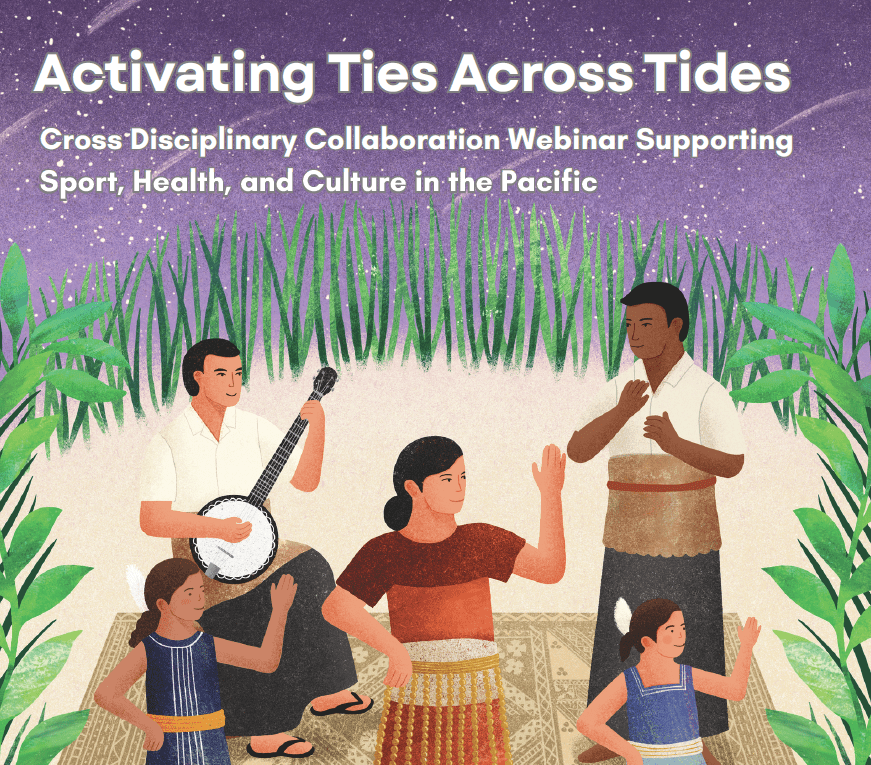
These were some of the comments of the over 115 registered participants from around the world attending the collaborative interdisciplinary webinar titled, “Activating Ties Across the Tides – Cross Disciplinary Collaboration Supporting Sport, Health, and Culture in the Pacific.”
Participants were from sports leadership, public health, Tribal government program, social work, primary care, private nonprofit social services, children & adolescent mental health, victim witness advocate. They attended from Papua New Guinea, Guam, Portugal, Alaska, and many more locations around the world.
The importance of culturally-grounded sport programs in Pacific communities was the theme and featured insights from sociologists, Olympians, educators, social workers, and public health practitioners from Pacific communities. Presenters shared innovative research, empowering youth programs, and personal stories with examples from Fiji, the Solomon Islands, and Chuukese communities in Guam.
This virtual event was jointly hosted by the Public Health Resonance Project and students in PH 672 Leading and Managing Health Programs in the Department of Public Health Sciences (DPHS) in collaboration with the Department of Social Work in the Thompson School of Social Work & Public Health at the University of Hawai‘i at Mānoa, the University of the South Pacific (USP), and the Foneni Achocho Sensu (FAS) Athletic Organization.
Featured speakers included John Howard, a distinguished athlete, public servant, and community leader who is originally from Fefan Island in Chuuk, Federated States of Micronesia (FSM)—a place known for its legacy of competitive runners – but has made Guam his home. He is part of the longstanding social work MSW distance education program in collaboration with UOG.
Hosted by Tetine Sentell, Professor in DPHS and Yoko Kanemasu, USP Sociology Professor, expert discussants included Haleavalu Ofahengaue Vakalahi, CEO of the Council on Social Work Education, Mapuana Antonio, Associate Professor in DPHS and head of the Native Hawaiian and Indigenous Health specialization, and Krista Schopy, a pediatric otolaryngologist born and raised on Hawaiʻi Island who is a student in the PH 672 class. Discussants connected the work across the Pacific with strength-based perspectives.
“It is great to see how communities are using sports/functional movement to support their communities to be healthier or find healthier ways to interact and to live.”
“Integrating culture and physical activity is an innovative way to create intersections between culture and health and a great way to strengthen communities socially and in health and wellbeing, thank you all for sharing what you do!”
“I love how discussants summarize and connect all the concepts of presentations together to see a broader picture of real-world practice with culturally safe and socially grounded application. Thank you so much for all presenters and sharing their point of different perspectives across gender, traditional sports, and youth athletic community.”
This webinar was followed by an open call for papers to continue to grow this area of scholarship and practice through the Hawaiʻi Journal of Health & Social Welfare in collaboration with the University of Hawai’i DPHS’ Hawai’i Health Data Warehouse Project, the Hawai’i State Department of Health Chronic Disease Prevention and Health Promotion Division, and the Public Health Resonance Project. The announcement can be found on the journal’s website. Abstract submissions are open until April 30.
This was the second collaborative Public Health Resonance Project webinar and supported by the Chin Sik & Hyun Sook Chung Endowed Chair in Public Health Studies and others. The previous webinar Culturally and Regionally Relevant Physical Activity Across the Lifespan & Across the Globe featured over 21 expert speakers from across the world and can be found on the Public Health Resonance Website along with other resources and scholarship.
The goal of the Public Health Resonance Project is to amplify the unique attributes and deep connections across regionally and culturally relevant physical activities to support health promotion and community participation, locally and globally.
“Having worked collaboratively across the Pacific for 20+ years to engage Pacific communities through social work and interdisciplinary public health initiatives at the University of Hawaiʻi at Mānoa, it was incredibly meaningful to see this interdisciplinary scholarly forum highlight efforts that center community and individual well-being through sport,” said Theresa Kreif, Faculty Director of Pacific Partnerships & Workforce Development Initiatives. “The Department of Social Work Workforce Development Hub was honored to participate, in particular the session included a panelist and current MSW students—who work for Child Protective Services on Guam and is also a former Olympian—share his impactful work with Micronesian communities.”
 Public Health Resonance Project